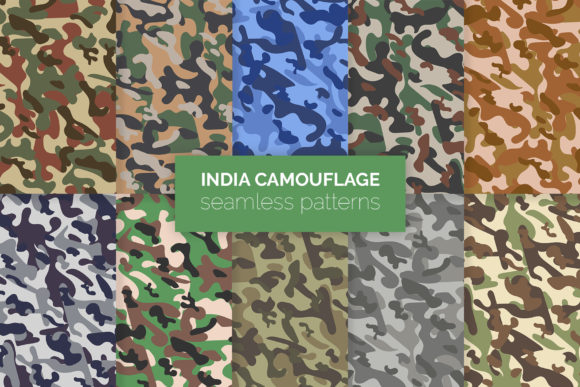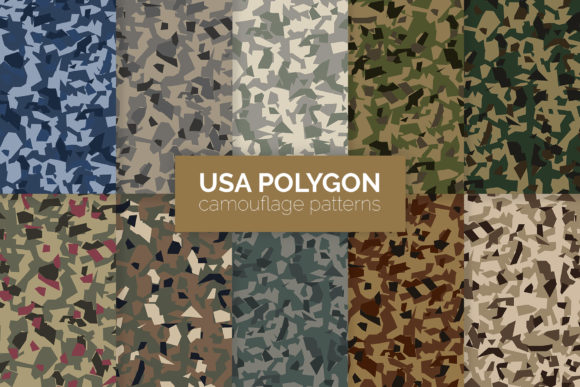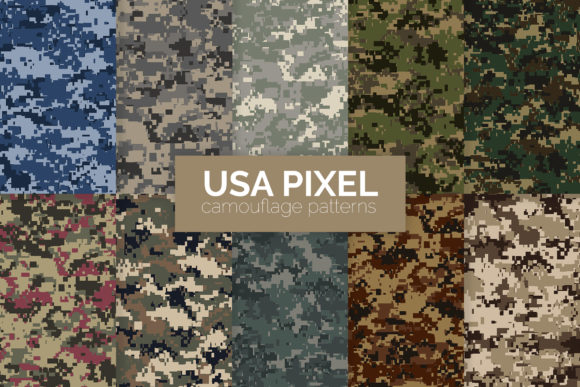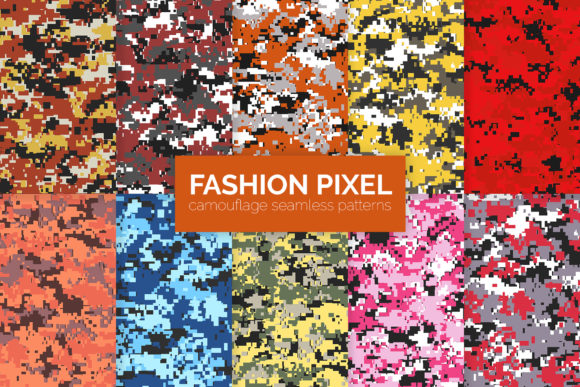
What Makes USA Camouflage Seamless Patterns Different From Standard Texture Packs
Digital designers, apparel producers, and product manufacturers often face a recurring challenge: finding surface designs that tile without visible seams while maintaining an authentic, region-specific aesthetic. USA Camouflage Seamless Patterns address this by combining traditional American military-inspired visuals with modern repeat-tiling technology. Unlike generic camo assets that might originate from international stock libraries with no clear design lineage, these patterns typically draw from recognizable woodland, desert, and urban motifs associated with U.S. military branches and outdoor heritage. The "seamless" designation means the pattern edge aligns perfectly with its opposite edge, allowing infinite repetition without jarring cut lines—something that matters enormously when printing on fabric yardage, wrapping 3D objects, or tiling website backgrounds.
But the category is broader than many newcomers realize, and rushing into a purchase without understanding how these patterns compare with alternatives can lead to mismatched expectations. Some patterns emphasize photorealism while others lean into stylized, vector-flat interpretations. Some include extended colorways beyond olive drab and khaki. The choice rests heavily on the end use, production method, and the specific visual language a project demands.
Understanding the Core Elements of USA Camouflage Seamless Patterns
At a technical level, a seamless repeat pattern is built so that every pixel at the right edge aligns with corresponding pixels at the left edge, and the same applies vertically. This sounds simple, but camouflage presents unique tiling challenges. Organic shapes—blobs, branches, leaf clusters, and irregular color fields—can create unintended horizontal or vertical banding when repeated if the designer does not carefully balance the distribution of elements across the tile boundary. High-quality USA Camouflage Seamless Patterns address this through deliberate boundary blending, offset testing, and multiple color-separation checks.
The "USA" dimension adds layers beyond technique. These patterns often reflect specific operational environments: the mixed hardwood forests of the eastern United States, the arid scrub of the Southwest, the muted grey-greens of Pacific Northwest coastal ranges. Some pattern sets explicitly reference historical military patterns like M81 Woodland, UCP, or OCP derivatives, while others create original interpretations that evoke the same visual language without replicating regulated designs. This distinction matters for licensing clarity—original interpretations avoid potential intellectual property complications while still delivering the aesthetic buyers recognize.
Digital Formats and Color Accuracy Across Production Methods
USA Camouflage Seamless Patterns typically ship as high-resolution raster files (JPEG or PNG at 300–600 DPI), layered PSD files, or scalable vector formats like AI, EPS, or SVG. The format choice heavily influences where the pattern can go. Raster files work well for digital printing on fabric, sublimation, and screen-printed applications but can show pixelation when scaled far beyond their native resolution. Vector patterns eliminate scaling concerns entirely and integrate more smoothly with cutting machines, engraving software, and large-format signage workflows.
Color management is another factor that separates serviceable patterns from production-ready assets. Patterns designed with CMYK output in mind behave predictably when sent to commercial printers. RGB-only patterns may look vibrant on screen but shift unexpectedly when converted for physical production. Some USA Camouflage Seamless Patterns include both color space versions, along with Pantone references for specific spot-color matching—particularly valuable for brands that need consistent camo elements across multiple product lines and manufacturing partners.
How These Patterns Compare With Generic Camouflage Alternatives
When evaluating USA Camouflage Seamless Patterns against broader camo resources, several practical differences emerge that affect workflow and final output quality.
Design Authenticity and Regional Specificity. Generic camo packs often default to a homogenized "global" aesthetic that blends European, Asian, and American influences into a non-specific pattern. For projects targeting American outdoor, tactical, or heritage-focused audiences, this vagueness can undermine credibility. A hunting apparel brand based in Colorado or a tactical gear manufacturer in Texas may find that USA-specific patterns resonate more authentically with their customer base than patterns that read as vaguely international.
Tile Engineering Quality. The seamless claim varies dramatically across providers. Lower-cost packs sometimes create a "mostly seamless" repeat by mirroring the pattern, which eliminates hard edges but produces unnatural symmetry that trained eyes notice immediately. True seamless tiling requires offset repetition without mirroring, preserving the organic randomness that makes camouflage effective as a concealment pattern—or at least convincing as a design element.
Licensing Clarity. Many generic pattern marketplaces operate with ambiguous licensing terms, particularly around commercial product use. Dedicated USA Camouflage Seamless Pattern collections often provide explicit commercial-use licenses, sometimes distinguishing between print-on-demand use, manufactured product use, and digital template redistribution. This clarity reduces legal exposure for businesses scaling production.
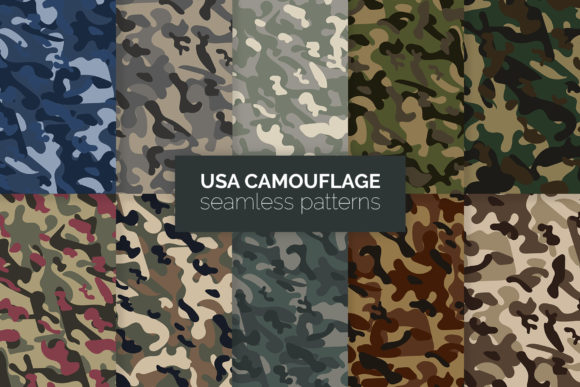
Colorway Variety. Traditional camo patterns stay within narrow color bands—browns, greens, tans, and greys. USA Camouflage Seamless Patterns increasingly offer expanded palettes, including subdued fashion colorways (dusty rose, slate blue, charcoal), high-visibility safety variants with blaze orange elements, and monochrome versions for engraving or single-color screen printing. This flexibility allows a single pattern structure to serve multiple product categories without purchasing separate assets.
Strengths and Practical Advantages in Real-World Use
For product designers working across multiple substrates, the consistency of these patterns reduces a persistent friction point. A seamless pattern tile that performs well on cotton canvas should ideally perform equally well on polyester microfiber, coated nylon, and rigid substrates like hydro-dipped hard goods. High-quality USA Camouflage Seamless Patterns maintain their visual integrity across these transitions because they are engineered at resolutions and color profiles suited for diverse outputs.
Time savings is another tangible benefit. Manually creating a seamless camo repeat in Photoshop or Illustrator can consume four to eight hours for a single pattern, assuming the designer has the technical skill to execute proper offset filtering and boundary blending. A pre-built, tested seamless pattern eliminates that labor entirely, letting the designer move directly to color adjustment, scale tweaking, and product mockup stages. For small studios and solo operators balancing multiple client projects, this efficiency gain translates directly to profitability.
Design compatibility also rates as a strength. Most USA Camouflage Seamless Patterns integrate readily with popular design tools—Adobe Illustrator's pattern swatches, Photoshop's pattern overlay layer styles, Procreate's canvas fill, and Cricut Design Space for craft cutting. This broad compatibility means teams do not need specialized software or plug-ins to use the assets effectively.
Tradeoffs and Limitations Worth Considering
No single pattern resource fits every project perfectly. USA Camouflage Seamless Patterns, for all their strengths, carry some inherent limitations that buyers should weigh before committing.
Scale Constraints. A pattern designed as a 12-inch repeat tile works beautifully for apparel and medium-format print, but may feel too dense or too sparse when applied to very small items (phone cases, patches) or very large surfaces (vehicle wraps, wall murals). Some providers offer multiple scale versions within a single pack, but others ship a single default repeat size. Checking the advertised tile dimensions before purchase helps avoid the frustration of patterns that look correct on screen but feel off-scale in production.
Aesthetic Range. The USA designation narrows the visual vocabulary. If a project needs a camouflage pattern specifically referencing European, Middle Eastern, or Asian military traditions, a USA-focused pack may feel culturally mismatched. Similarly, projects requiring highly stylized or abstract camo—geometric, watercolor, glitch-art—will likely need supplementary assets from different sources.
Overuse Risk. Popular seamless patterns, particularly affordable ones sold through large marketplaces, can appear across many products simultaneously. A distinctive custom pattern offers brand separation that a widely available asset cannot match. Companies building long-term brand identity around unique camo may eventually need to commission exclusive pattern development rather than relying on commercial packs indefinitely.
File Size and Performance. High-resolution seamless patterns, especially 600 DPI multi-layer PSD files, can exceed 100MB per pattern. This file weight matters when building large digital mockup libraries or when loading patterns into web-based design tools. Vector alternatives typically run much smaller, but they may not capture the subtle texture and grain that give raster camo its tactile feel.
When USA Camouflage Seamless Patterns Are the Right Choice
These patterns shine in specific scenarios where their design heritage and technical properties align with project requirements. Small to mid-size apparel brands launching outdoor, tactical, hunting, or patriotic-themed product lines benefit from the instant authenticity these patterns provide without the lead time and expense of custom camo development. Print-on-demand sellers creating merchandise for American outdoor enthusiasts, veterans' organizations, or regional tourism markets find the regional specificity boosts conversion over generic alternatives.
Product mockup workflows also reward seamless camo assets. Designers building client presentations for camouflage-printed gear can quickly apply patterns to 3D models in software like Blender, Cinema 4D, or Adobe Dimension, producing convincing previews without photographing physical samples. The seamless tiling ensures that UV-mapped 3D surfaces show no visible repeats or distortions. Crafters and small-batch makers using cutting machines appreciate vector camo patterns for vinyl decals, heat-transfer designs, and etched metal goods—applications where crisp edges and scalable geometry are non-negotiable.
Interior design and event production occasionally draw on camo patterns for themed environments, backdrops, and custom upholstery. In these contexts, USA Camouflage Seamless Patterns provide a consistent visual thread across diverse surface materials, from fabric draping to printed rigid panels.
Scenarios Where Alternative Approaches May Serve Better
Large-scale commercial brands investing heavily in proprietary product identity often reach a point where off-the-shelf patterns, however well-made, cannot provide sufficient market differentiation. In these cases, hiring a textile designer or surface pattern specialist to develop exclusive camo from scratch becomes a strategic investment rather than an avoidable expense. The resulting pattern aligns perfectly with brand color systems, incorporates subtle brand markers, and remains unavailable to competitors.
Projects requiring extremely specialized camouflage—active military contracts, scientific field equipment for specific biomes, or camouflage optimized for non-visible spectra—demand engineering-level pattern development informed by environmental data and visibility studies. Commercial USA Camouflage Seamless Patterns, designed primarily for aesthetic and commercial applications, typically lack this rigorous performance optimization.
Web and app designers seeking ultra-lightweight assets may also need to look elsewhere. Large seamless raster patterns can bloat page load times if not aggressively compressed, and vector camo with many organic nodes can slow rendering in some browser contexts. CSS-generated patterns or SVG filters might provide lighter alternatives for digital-only use, though they rarely match the visual richness of a well-crafted seamless camo tile.
Evaluating Pattern Quality Before Integrating Into a Workflow
Testing a seamless pattern before committing it to production saves time and material cost. A simple yet effective check involves placing the pattern tile into design software, duplicating it into a 3x3 or 4x4 grid, and zooming in on the seams. Any visible repetition artifacts, color mismatches at boundaries, or unnatural clustering of elements indicate incomplete tiling. Rotating the pattern 90 degrees and repeating the test can reveal directional bias that may not appear in the original orientation.
Print-testing on the intended substrate, even at a small scale, reveals how colors and scale translate from screen to physical output. A pattern that looks crisp at 100% zoom on a monitor may lose critical detail when ink hits absorbent fabric or when dye-sub heat transfers slightly blur the edges. USA Camouflage Seamless Patterns sold with accompanying print-test guidance or substrate recommendations typically reflect a higher level of production awareness from the creator.
Metadata and documentation matter as well. Pattern files named descriptively (for example, "USA_Woodland_Seamless_12inch_300DPI_CMYK") signal organizational care that speeds up asset management in production pipelines. Patterns dumped into downloads with cryptic alphanumeric names cost time every time a designer hunts through folders for the right file.
Integrating Camo Patterns Into a Cohesive Design System
USA Camouflage Seamless Patterns rarely operate in isolation. They interact with solid colors, typography, logo placement, and product silhouettes. A pattern that overwhelms accompanying design elements loses its supporting role. Successful integration often involves scaling the pattern to an appropriate size relative to the product, muting or adjusting colors to harmonize with brand palettes, and using the pattern selectively rather than on every available surface.
Some designers apply a subtle overlay—a slight grain texture, a soft vignette, or a color wash—to unify the camo pattern with the broader design language. Others use the pattern as an accent element, restricting it to interior linings, pocket flaps, or sleeve panels while keeping main body panels in solid colors. These restrained applications often achieve more sophisticated results than all-over camo saturation.
Ultimately, USA Camouflage Seamless Patterns function as a resource that solves a specific technical and aesthetic problem: the need for regionally recognizable, technically sound repeating camouflage designs that integrate smoothly into modern production workflows. They are not the only solution—custom development, minimalist digital approaches, and alternative regional camo traditions all have their places—but for a broad swath of commercial and creative applications, they represent a practical, immediately deployable asset class that bridges the gap between authentic American camo heritage and contemporary design requirements.