Integrating Terrazzo Seamless Patterns into Modern Creative Workflows
For professionals working across graphic design, web development, interior planning, and digital art, the quest for high-quality, versatile, and cohesive visual assets is a constant practical challenge. Enter Terrazzo seamless patterns. This isn't merely a decorative trend; it's a functional asset class that addresses specific needs within a production pipeline. Understanding what these patterns are and how they fit into broader processes is key to leveraging them effectively.
What Terrazzo Seamless Patterns Represent in a Practical Context
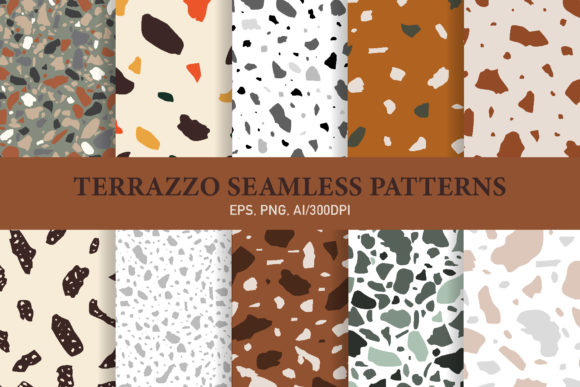
Terrazzo seamless patterns are digital or physical design motifs inspired by the classic terrazzo flooring technique—a composite of chips of marble, quartz, granite, or glass set in a binder. In a seamless pattern, this aesthetic is translated into a tileable graphic that repeats infinitely without visible joins. This creates a continuous, uniform surface ideal for backgrounds, textures, and large-scale applications.
From a workflow perspective, these patterns are more than just a "look." They are ready-to-implement assets. Their value lies in their prepared state. A designer or creator sourcing a terrazzo seamless pattern is acquiring a solution to a common problem: the need for a consistent, non-distracting, and aesthetically polished base layer. This fits into the early stages of a project, often during the visual foundation phase, where mood boards, color schemes, and core textures are established.
Where Terrazzo Patterns Fit: From Project Initiation to Final Output
The integration of terrazzo seamless patterns can occur at multiple points in a project lifecycle. At the outset, they can serve as a defining element in a brand's visual identity or a website's overall feel. During the execution phase, they become a practical tool for filling large areas quickly while maintaining quality. Finally, in refinement, they provide a backdrop that unifies other elements without competing for attention.
Consider a web designer building a landing page. After defining the color palette and typography, the search for a suitable background begins. A generic, non-seamless image would require tedious manual editing to fit different screen dimensions. A pre-made terrazzo seamless pattern, however, can be applied as a CSS background-image with `background-repeat: repeat;`, instantly covering all areas elegantly and responsively. This preparation advantage translates directly into time savings and technical simplicity.
Interaction with Tools, Platforms, and Team Workflows
Terrazzo seamless patterns are not isolated artifacts; they interact dynamically with the tools and people in your process. In software like Adobe Photoshop, Illustrator, or Figma, these patterns are imported as image fills or placed as smart objects. Their seamless nature ensures that scaling or extending the canvas doesn't break the design. For digital publishing platforms like WordPress or Shopify, they are uploaded as asset files and applied through theme settings or page builders.
From an organizational standpoint, having a library of curated terrazzo patterns—perhaps categorized by color family or scale—enhances efficiency. It allows a design team to maintain consistency across multiple projects or marketing materials. A social media manager, for instance, could use a specific terrazzo pattern as a recurring background for a series of campaign graphics, creating a subtle but recognizable thread through all outputs. This speaks directly to quality control and brand coherence over the long term.
Practical Implementation: Tips for Smooth Integration
To integrate terrazzo seamless patterns smoothly into your work, start with compatibility. Ensure the pattern file's resolution and format (PNG, JPG, SVG) match the requirements of your end medium—web use demands smaller file sizes, while print may require high-resolution vectors. Usability is paramount; test the pattern in a mock-up to see if it performs as intended across different scales and contexts.
For implementation, a straightforward workflow example might be:
- Identify the project's need for a neutral, textured, or colorful base.
- Select a terrazzo seamless pattern from your asset library that aligns with the project's color psychology and spatial requirements.
- Apply it in your design software as a background layer, setting it to tile.
- Place your primary content (text, images, UI elements) over it and evaluate readability and visual hierarchy.
- Export the final design, confirming the pattern remains seamless in the output.
A useful observation is that terrazzo patterns, due to their inherent complexity and speckled nature, often work best when used with ample contrast. Pairing a busy pattern with very clean, minimalist foreground elements usually yields the most professional and legible result.
Factors for Long-Term Use and Asset Management
Thinking beyond a single project, terrazzo seamless patterns offer value as reusable assets. Their durability in a workflow hinges on organization. Create a dedicated digital folder or asset management platform entry for your collection. Tag patterns with keywords like "subtle," "bold," "neutral," or "vintage" to facilitate quick retrieval later.
Efficiency is gained when these patterns reduce the need to create custom textures from scratch for every new task. For a freelance graphic designer serving multiple clients, having a pre-approved set of patterns can speed up initial concept presentations. For a small business owner designing their own marketing materials, using a consistent terrazzo pattern across website, flyers, and packaging creates a professional, unified appearance without requiring deep design expertise.
Consider also the factor of adaptability. Many terrazzo seamless patterns are editable. In applications like Illustrator, the color of the binder or chips can be altered to match a new brand palette, making a single pattern asset versatile across different campaigns or seasonal updates. This extends the asset's lifespan and ROI.
Use Cases Across Different Roles and Goals
The application of terrazzo seamless patterns spans the audience of creators, entrepreneurs, and educators. A blogger might use a gentle, gray-scale terrazzo pattern as a full-width background to make their text-centric site feel more designed and engaging. An educator creating online course materials could employ a bright, playful pattern in presentation slides to maintain visual interest without distracting from the core information.
In a business workflow, these patterns find a place in internal document design, pitch decks, and even physical product mock-ups where a texture needs to be applied to a 3D model. The key is identifying the functional requirement: the need for a scalable, non-repetitive-looking texture that fills space intelligently.
For personal projects and hobbies, such as designing custom invitations or crafting digital art, terrazzo seamless patterns offer an easy route to a sophisticated result. They remove the technical barrier of creating a perfect, manual repeat pattern, allowing the hobbyist to focus on composition and message.
Seamless Integration for Cohesive Outcomes
Ultimately, the goal of incorporating terrazzo seamless patterns into any process is to achieve cohesion and quality with less friction. By treating these patterns as practical components—similar to selecting a font or a stock photo—you can streamline the visual development phase of your work. Their strength lies in their prepared, infinite repeat structure, which solves a specific technical and aesthetic problem inherent in covering large surfaces.
To adopt them effectively, assess your common projects for moments where a textured background is beneficial. Build a small, well-organized library of patterns that match your style or brand needs. Understand the technical steps to apply them in your primary tools. Then, observe how their use enhances consistency across your outputs and reduces the time spent on foundational design tasks. When integrated thoughtfully, terrazzo seamless patterns become not just a decorative choice, but a reliable part of a productive creative or business workflow, delivering polished visual results through a process-oriented approach.