Watercolor Feathers Patterns: How to Choose and Use Vector Designs Without the Common Pitfalls
Soft, airy, and full of quiet movement, watercolor feather patterns have surged in popularity across branding, stationery, home décor, and digital art. When crafted as Watercolor Feathers Patterns. Vector files, they offer a rare blend of hand-painted charm and crisp technical precision. But many people jump into using these assets only to encounter blurry prints, color surprises, or awkward licensing situations. Understanding exactly what you’re working with — and where things typically go sideways — turns a lovely design element into a reliable tool you can use across dozens of projects.
What Makes a Watercolor Feather Vector Pattern Different
At first glance, you might think all feather graphics are interchangeable. In reality, there’s a crucial difference between a flat raster image and a true Watercolor Feathers Patterns. Vector file. A photograph or scanned painting saved as a JPEG or PNG has a fixed number of pixels. Enlarge it beyond its native resolution, and the edges soften into mud. A vector file, on the other hand, stores the image as mathematical paths and curves. That means a single watercolor feather motif can be scaled from a tiny business card logo to a wall mural without any loss of quality.
However, not every file labeled “vector” behaves this way. Some sellers embed a low-resolution watercolor texture inside a vector container, creating a hybrid file that doesn’t truly scale. The feather might stay sharp while the delicate paint washes pixelate. This is one of the first overlooked details that trips up beginners and even experienced designers who assume “vector” guarantees universal crispness.
The Trap of Low-Quality Live Trace Conversions
Many budget-friendly or free Watercolor Feathers Patterns. Vector downloads are not originally drawn as vectors. They begin as scanned hand-painted artwork and are then run through auto-trace software. The result often includes thousands of unnecessary anchor points, jagged edges on what should be soft washes, and color banding where gradients should flow. When you open the file in Adobe Illustrator or Affinity Designer, you’ll notice the path structure is chaotic, making it nearly impossible to recolor or simplify the design cleanly.
This isn’t just an aesthetic concern. Overly complex vectors cause software to lag, increase file sizes dramatically, and can crash RIP software when sending large-format prints to a commercial printer. A better approach is to look for patterns that were originally designed with vector watercolor brushes or carefully hand-digitized using a thoughtful combination of mesh gradients and transparency masks. These assets maintain the organic feel without sacrificing editability. Before purchasing, check if the creator provides a close-up preview of the vector structure or a description of the construction method. If a file claims to be fully scalable yet the preview looks like a chunky autotrace, consider it a warning sign.
Color Modes and the Unforgiving CMYK Shift
One of the most consistent frustrations with watercolor vector patterns happens during printing. Many digital downloads are created in RGB color mode, which displays vibrant, luminous hues on screens. Watercolor pigments are naturally translucent, and their beauty in digital form often relies on subtle layering and brightness that RGB handles well. But when you send an RGB watercolor feather to a commercial printer or even your home inkjet expecting identical results, the conversion to CMYK can flatten the translucency and shift gentle pastel tones into dull, muddy colors.
Professionals working with Watercolor Feathers Patterns. Vector for packaging, wedding invitations, or fabric avoid this by checking the color profile before applying the design. If the file is only available in RGB, they manually adjust the artwork in a CMYK document using soft-proofing tools and gamut warnings to see the shift in advance. In many cases, slightly boosting saturation or adjusting the cyan balance in the feather’s wash areas before conversion preserves a better likeness. If print accuracy is critical, prioritize purchasing from sources that provide a CMYK-compatible version or at least indicate that the palette is print-friendly.
Licensing Blind Spots That Can Hurt a Business
It’s easy to get excited about a beautiful set of watercolor feather vectors and start using them on Etsy products, client websites, or merchandise without reading the fine print. Standard licenses often restrict the number of end products, prohibit use on print-on-demand platforms, or forbid redistribution in a way that many small business owners overlook. You might create a lovely throw pillow design using a watercolor feather pattern and list it on a print-on-demand site, only to find the file’s license explicitly excludes this because the artwork is being resold as a standalone decorative element rather than as part of a larger design you’ve significantly transformed.
Equally risky is assuming “free” assets are safe for commercial work. Many free vector sites host uploads by users who don’t own the original rights. The watercolor feather pattern you downloaded from a free repository could be a traced copy of a copyrighted illustration, exposing you to takedown notices or legal claims. A safer path is to source from reputable marketplaces that verify sellers, or to look for extended commercial licenses that clearly state allowed uses. Keep a copy of the license file and purchase receipt in your project folder. This simple habit prevents panic months later when a client asks for proof of rights.
When “Seamless” Isn’t Actually Seamless
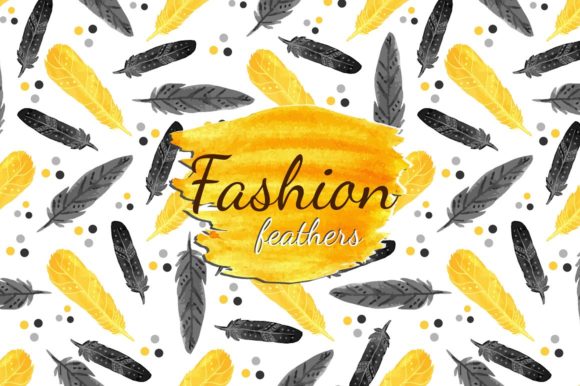
Many Watercolor Feathers Patterns. Vector products are advertised as seamless repeating patterns. In practice, the repeat can have visible hard lines where watercolor edges meet, or the spacing feels unnatural. This often happens because the creator built the tile by simply cropping a larger artwork without carefully blending the edges or testing the repeat. When you apply such a pattern across a large surface — like a website background or a bolt of fabric — the repetition becomes distractingly obvious.
A quick quality check before committing to a purchase or a project saves hours of frustration. If the preview includes a tiled example, scale it up in your mind or on screen and look for horizontal or vertical seams. A well-made watercolor feather repeat should feel organic, with feathers overlapping the tile boundaries and transparent washes bridging the gaps so the eye can’t detect the grid. If you’re creating the pattern yourself, use offset filters in your design software to shift the artwork and blend the exposed seams with additional feather elements or soft washes. Even a few minutes spent refining the tile edges can turn a choppy repeat into a fluid, professional surface.
The Misunderstanding of “Editable” Vector Files
A common assumption is that buying a vector file means you can easily change every color. With solid, flat vector shapes, that holds true. But watercolor textures rely on layered transparencies, blending modes, and often embedded raster textures to achieve that soft, pigmented look. When you select a feather in a Watercolor Feathers Patterns. Vector set and try to swap its soft teal wash to a warm terracotta, you might end up with an opaque block instead of a translucent brushstroke. The editability headache stems from the fact that many of these patterns aren’t built with global color swatches or live blends; they’re assembled from dozens of individual gradient mesh points and clipping masks.
Rather than avoiding richly textured vector files, a better approach is to understand what’s truly editable before you buy. Look for file descriptions that mention “easy recoloring” or “layered EPS” only if the preview shows a modular file structure. Test an inexpensive or free sample from the same creator if available. Alternatively, adjust your workflow: instead of trying to recolor the intricate wash directly, many designers place the feather pattern on a top layer and use blend modes like Multiply or Overlay with colored shapes underneath. This technique preserves the watercolor texture while giving you control over the overall hue. It also works beautifully when you want to maintain the original paper-like translucency.
Sizing and Resolution for Multi-Platform Use
Even perfect vector files can lead to disappointing results if the feather motifs are sized incorrectly for the intended canvas. A delicate feather design created at a small scale might lose its fine details when blown up for a storefront window graphic, simply because the painterly strokes become too sparse or the composition feels empty. Conversely, a highly detailed feather pattern that looks stunning on a desktop wallpaper can become an illegible muddle when shrunk for a mobile app icon.
The most practical step is to mock up the pattern in context at the exact pixel dimensions or print dimensions it will be used. For digital screens, export at 1x resolution and view it on the target device. For print, view a test strip at 100% scale on your monitor and print a small section on the actual stock paper if possible. With Watercolor Feathers Patterns. Vector, scaling up is technically easy, but visually successful scaling depends on whether the artwork’s density and composition hold up. When in doubt, choose a set that includes feathers at multiple natural sizes or one that has already been tiled at the typical repeat size for your industry, such as a 12×12 inch repeat for scrapbooking paper or a continuous yard-size repeat for fabric.
Better Selection Starts with a Short Checklist
Before you click “buy” or “download,” running through a few verification points will save you from almost all the frustrations mentioned. First, confirm the file formats included: look for AI, EPS, or SVG, not just a PSD with vector smart objects. Second, read the license terms specifically for print-on-demand, digital resale, or logo use — whatever fits your project. Third, examine the preview image at full zoom if possible, checking for jagged autotrace artifacts around the feather’s barbs and any harsh seams in the repeat. Fourth, open one file in your vector software if you have access to a freebie from the same seller, verifying that the layers are organized and the color mode is clearly documented.
These steps take less than five minutes but repeatedly protect designers, bloggers, and small business owners from costly re-dos. Watercolor vectors are an investment in creative flexibility, and a small amount of upfront scrutiny ensures that flexibility is real, not just promised in the product title.
Making the Most of Watercolor Feathers in Your Projects
Once you have reliable files, the creative possibilities expand rapidly. Use feathered frames around quotes on social media, layer translucent feather patterns over photography for elegant wedding websites, or create custom fabric for product mockups. When applied thoughtfully, Watercolor Feathers Patterns. Vector add a tactile, handcrafted softness that purely digital geometric patterns can’t replicate. If you ever feel stuck, remember that the best results often come from pairing the organic watercolor elements with clean, modern typography or generous white space. The contrast elevates both the pattern and the overall design, letting each feather feel like a deliberate brushstroke rather than a filler.
Paying attention to the technical underbelly of vector watercolor feathers may not sound glamorous, but it’s the invisible skill that keeps creative work looking polished at every size, on every surface, and in every commercial context. By side-stepping the common errors — faulty autotraces, color mode oversights, weak repeat tiles, and license ambiguities — you transform a pretty digital asset into a worry-free, endlessly reusable resource that bends to your imagination instead of breaking under real-world demands.