Seamless Middle Eastern Patterns: A Designer's Guide
In the world of design, patterns are more than mere decoration; they are a language. The rich, intricate, and profoundly symbolic motifs originating from the Middle East have captivated artists for centuries. Today, a modern interpretation known as Seamless Middle Eastern Patterns is making a significant impact across digital and physical spaces. These are not static, isolated designs but adaptable, continuous systems of visual elements that can tile infinitely without visible breaks, creating a cohesive and immersive aesthetic.
Why should a modern professional care about these historical patterns? Because Seamless Middle Eastern Patterns solve a contemporary problem: the need for depth, cultural resonance, and visual harmony in a world saturated with generic, minimalist design. They offer a bridge between timeless artistic heritage and the functional demands of today's projects, from website backgrounds to product packaging.
The Defining Characteristics of These Patterns
What sets Seamless Middle Eastern Patterns apart from other ornamental styles? First, look for geometric precision. Islamic art famously avoids figural representation, favoring intricate geometry that reflects spiritual concepts of infinity and unity. These patterns are built on mathematical principles, often featuring interlocking stars, polygons, and arabesques that flow without beginning or end.
Secondly, there is a deep emphasis on symmetry and balance. Whether based on a four-fold, six-fold, or eight-fold rotational symmetry, the designs feel inherently stable and ordered. This isn't chaotic ornamentation; it's calculated harmony. Finally, observe the seamless integration itself. When executed correctly, you cannot find the "edge" of the pattern. It repeats perfectly, creating an endless field that can cover any surface area without awkward seams or misaligned elements.
From Historical Art to Digital Asset
The transition of these motifs into seamless, digital-ready assets is a key development. Traditional zellige tilework or manuscript illuminations were hand-crafted for specific, finite spaces. Modern vector-based Seamless Middle Eastern Patterns retain all the symbolic complexity but are engineered for scalability and repetition. This makes them incredibly versatile digital assets, ready to be applied as backgrounds, textures, or decorative elements in a myriad of contexts.
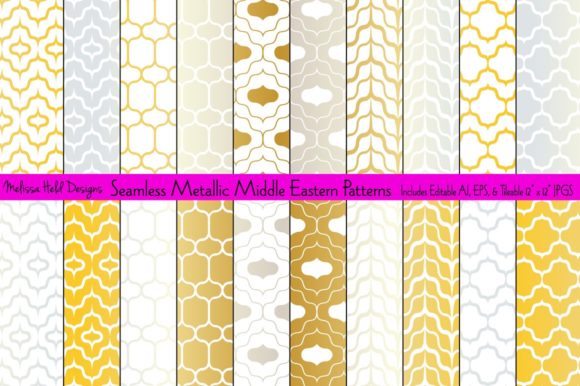
Their notable qualities include adaptability. They can be rendered in monochrome for a subtle texture or exploded into vibrant color palettes for a bold statement. They also possess an inherent cultural weight that conveys sophistication, history, and global awareness—a valuable nuance for brands and creators looking to communicate beyond superficial aesthetics.
Practical Applications Across Industries
The utility of Seamless Middle Eastern Patterns is vast, precisely because they are not just "pretty pictures" but functional design systems.
For digital professionals and marketers, these patterns offer an instant upgrade to user interface (UI) backgrounds, website hero sections, or social media graphic textures. The seamless nature ensures the design doesn't break at different screen resolutions, maintaining a professional and polished appearance. A fintech app might use a subdued, metallic-toned pattern to convey stability and intricate security; a travel brand could use a vibrant, colorful iteration to evoke the richness of a destination.
Educators and publishers can use them in presentation templates, educational materials, or book covers to add visual interest that doesn't distract from content. The patterns can frame information without overwhelming it, making them excellent for slide decks or report borders.
In the creative and entrepreneurial space, these patterns are gold for physical product design. Imagine a line of notebooks, ceramic mugs, or packaging for a specialty coffee brand featuring a seamless geometric pattern. It creates a cohesive brand identity that feels artisan-crafted and globally inspired. Freelancers can use them in their own brand collateral to stand out from competitors using stock imagery.
Enhancing Brand Communication and User Experience
When implemented thoughtfully, the benefits are tangible. From a usability perspective, a well-chosen pattern can improve visual hierarchy. Used as a subtle background, it can help define a section of a webpage without competing with foreground text or buttons. In terms of branding, these patterns carry associative meaning—craftsmanship, intelligence, heritage—that can enrich a brand's narrative without a single word.
For user experience (UX), a seamless pattern provides a sense of environmental completeness. A broken or misaligned background texture can subconsciously signal carelessness or technical error. A perfect seamless pattern, conversely, signals attention to detail and a seamless (pun intended) digital environment, fostering trust and engagement.
Consider a real-world example: an online art gallery specializing in contemporary Middle Eastern artists. Using a custom, seamless pattern derived from traditional motifs as the site's framing element creates a perfect contextual bridge. It tells the visitor, "You are entering a space dedicated to this culture," before they even see the first artwork.
Selecting and Implementing Patterns Wisely
Not every Seamless Middle Eastern Pattern is suitable for every project. Here are practical considerations for selection and use.
Evaluate the pattern's density and scale. A highly dense, complex pattern might be breathtaking as a standalone art piece but could become visual noise as a full-screen background. Look for versions with larger, more open repeats for such applications. Conversely, a very fine, intricate pattern might work beautifully as a textured border or a small-element repeat on fabric.
Consider color adaptability. Many patterns are offered in single-color or grayscale versions. This is crucial for brand integration. Can you easily recolor it to match your primary brand palette? Vector formats (like SVG) are ideal for this.
Mind the cultural context. While these patterns are beautiful, using them requires a degree of respect and understanding. Avoid slapping them onto products or campaigns with unrelated or disrespectful messaging. The pattern should feel like an integrated part of your story, not a superficial appropriation.
Technical implementation matters. Ensure the pattern file is truly seamless. Test it by tiling it multiple times in your design software (Photoshop, Illustrator, Figma) before committing. Check for performance on web projects—a very large, detailed pattern file might need optimization to avoid slowing page load times.
A Tool for Distinctive and Meaningful Design
Ultimately, Seamless Middle Eastern Patterns represent a powerful tool in the designer's arsenal. They move beyond the transitory trends of flat design or brutalism, offering a connection to a deeper, mathematical, and spiritual art history. For the professional, marketer, or creator seeking to infuse their work with elegance, narrative depth, and visual continuity, these patterns provide a ready-made solution.
They remind us that in a digital age obsessed with the new, there is immense value in patterns that have resonated for millennia. By adopting and adapting these seamless systems, we can create environments—both on screen and in physical space—that are not only visually engaging but also culturally intelligent and harmoniously complete.